Key takeaways
- Light the routes and rooms you use after dark — paths, arrival, specimen trees, outdoor living — not every shrub.
- Low-voltage work lives or dies on transformer size, cable runs, aim, and a nighttime review.
- Point light at the subject; keep spill off windows, lot lines, and the night sky.
- If hardscape is still open, place sleeves and the transformer before finish surfaces close.
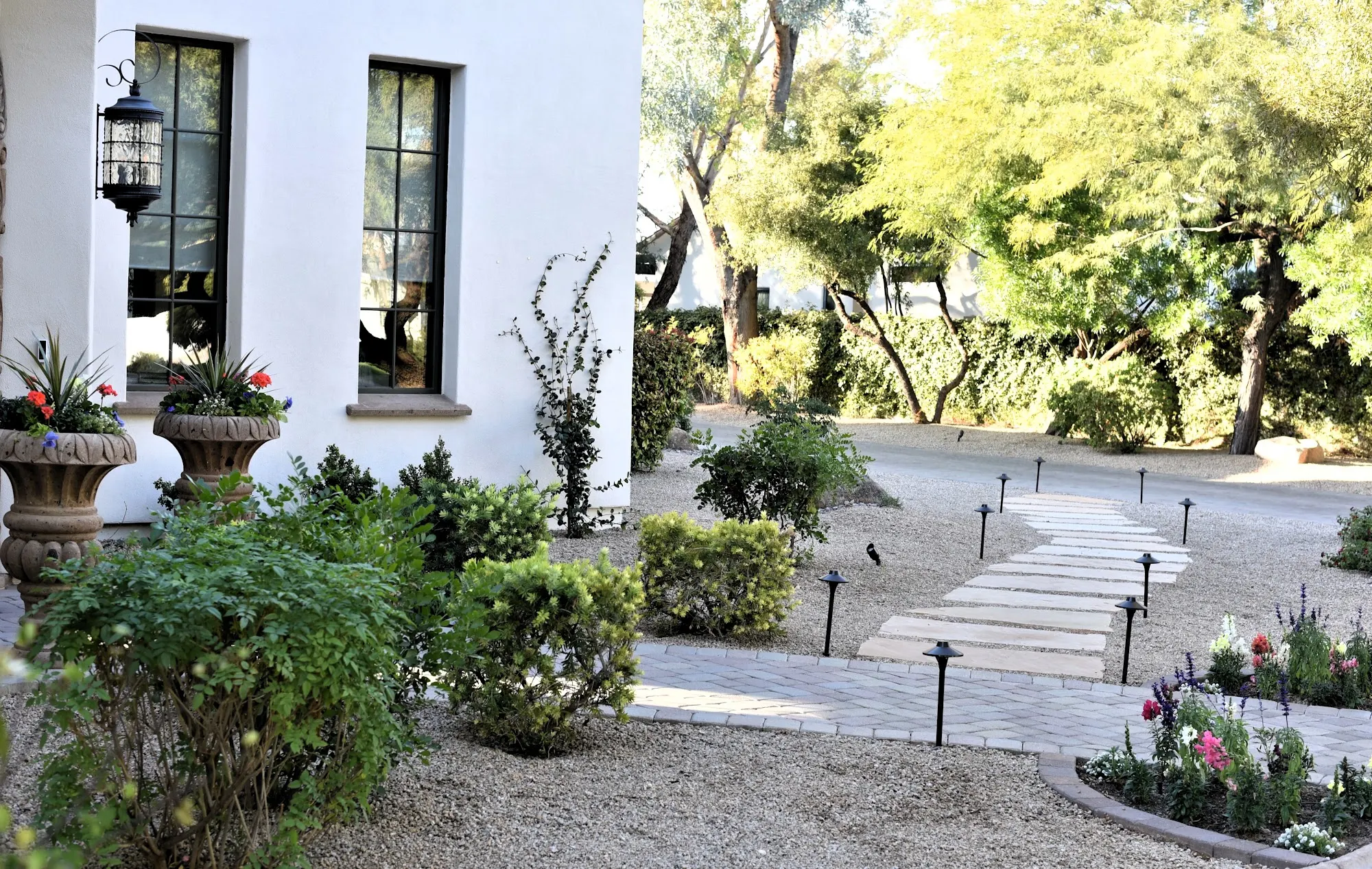
By late afternoon in Scottsdale, the heat still radiates off the stucco. Dinner moves outside. Guests walk the path from the driveway. The ironwood that looked sculptural at noon goes flat in the dark — unless the lighting plan catches up.
That is the real season for outdoor living in the Valley. Landscape lighting Scottsdale homeowners ask about is not decoration first. It is how you keep the yard usable, readable, and calm once the sun drops.
This guide covers what to light, how low-voltage systems are built, how to avoid glare, and how Kim and Alfred approach a clean install. For service scope, see landscape lighting, plus Scottsdale, North Scottsdale, and Paradise Valley.
Why evenings are when your yard earns its keep
Answer first: light the property for how you live after sunset, not for a daytime photo.
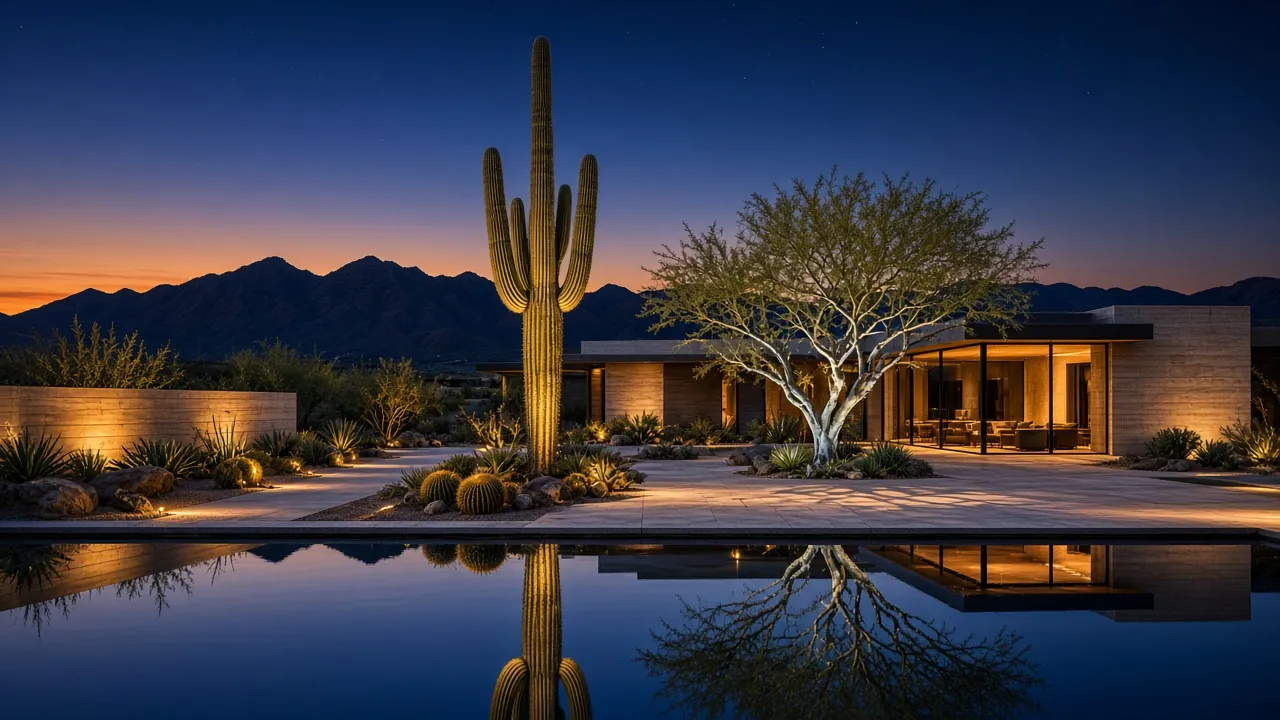
Cooler air is when patios, paths, and outdoor rooms get used. Without lighting, a finished hardscape becomes a trip hazard and a black cutout from the street. With a restrained plan, the same trees and walls that carry the design at noon keep working after dinner.
Lighting also changes the view from inside the house. A lit trunk, a grazed stone wall, a path that leads to the door — those are the cues that say the landscape is finished. That is why lighting often rides with a landscape redesign, and why it still works as a focused add-on when the hardscape is already in place.
How a low-voltage system actually works
Answer first: most residential landscape lighting here is low-voltage — a transformer, buried cable, and fixtures aimed at real subjects.
Line-voltage landscape lighting exists. For typical paths, trees, and outdoor rooms, low-voltage is what homeowners and installers usually mean by a finished nighttime look.
The label matters less than the system:
- A transformer sized for the fixture load, with room if the plan may grow
- Cable runs planned for distance so the far fixtures do not go dim
- Fixtures aimed at surfaces — not into eyes or across the lot line
- Controls that match how you use the yard (dusk-to-dawn, timers, or zones)
If a quote lists fixture counts and skips transformer location, wire layout, and nighttime aiming, ask for those pieces. That is where installs hold up after the first summer — or fail.
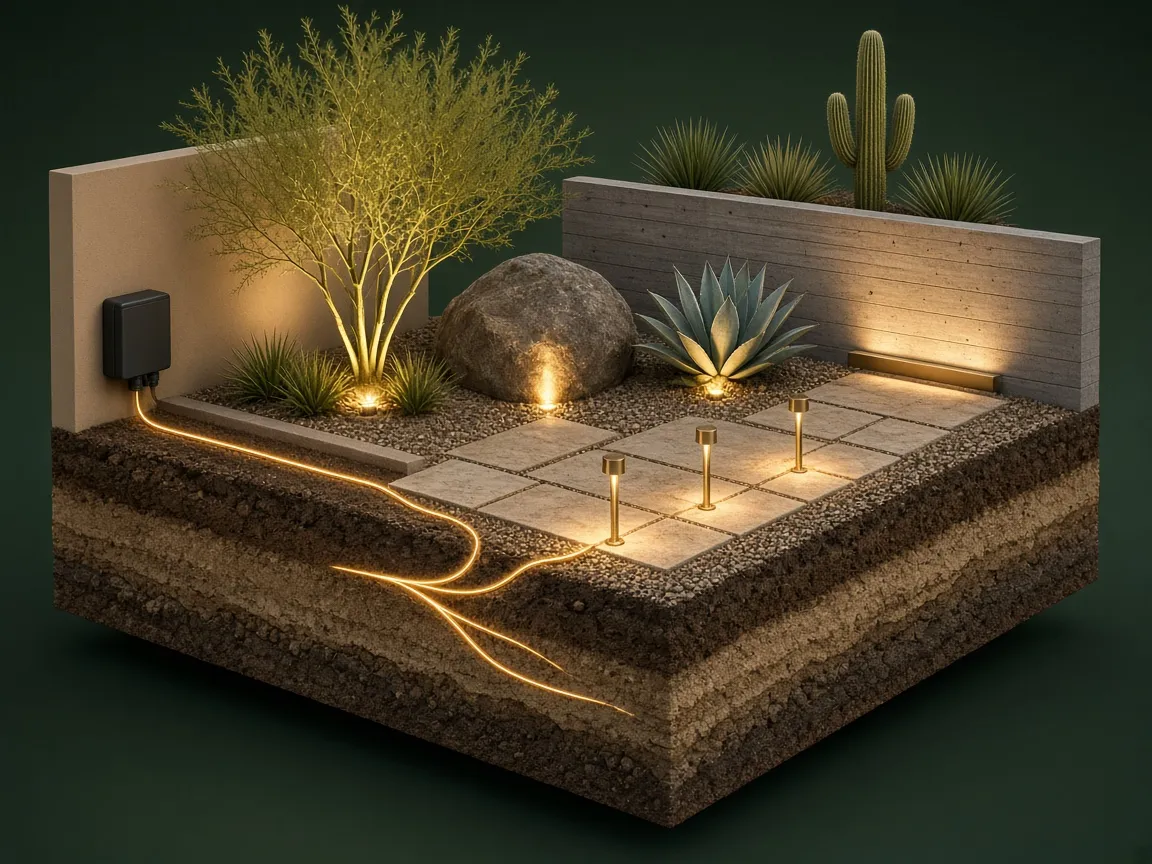
- Transformer
- Buried low-voltage cable
- Tree uplight
- Well light
- Path lights
- Wall wash
What to light first (and what to skip)
Answer first: light movement and gathering first — paths, arrival, strong trees, outdoor living edges — then stop.
Start with how people walk and sit after dark, not with a catalog of every plant.
Light these early
- Paths and steps — so nobody guesses the next tread
- Arrival and entries — so guests find the door and the street face looks finished
- Trees with real structure — trunks and canopies that already carry the daytime design
- Outdoor living edges — dining, fire features, seating walls, patio-to-planting transitions
- Key architectural faces — walls that earn light, not blank glare boards
Skip these first
- Every shrub in a bed (busy, glare-prone, hard to maintain)
- Zones nobody uses at night
- Flood washes that erase depth and wash the neighbor’s glass
Fewer well-aimed fixtures usually beat a crowded plan. Two tree lights and a clear path run often outwork a dozen scattered spots.
Keep the glow on your lot — not your neighbor's
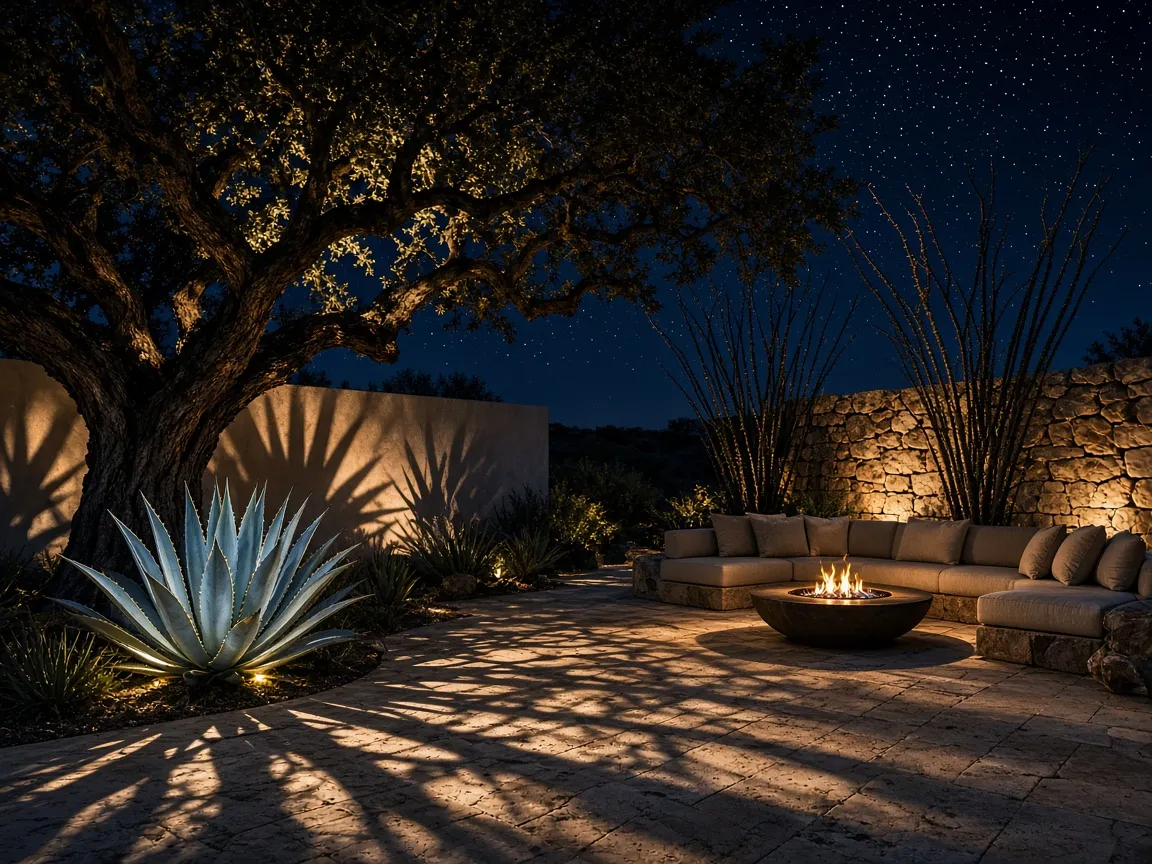
Answer first: aim is as important as brightness.
In denser Scottsdale pockets and on Paradise Valley lots near shared edges, light that hits a window or bounces off light stucco reads as glare, not welcome.
Habits that keep systems neighbor-friendly:
- Aim down or onto the subject — path, trunk, wall — not out across the lot line
- Prefer shielded or hooded fixtures where sightlines go toward other homes
- Soften bright vertical surfaces; stone and stucco throw light farther than you think
- Review after dark and adjust — paper aim is only a draft
If you have an HOA, check exterior lighting rules before fixtures go in the ground. Confirm early; redesign later costs more patience than a phone call.
Materials that survive Valley sun
Answer first: choose fixtures and cable built for long sun exposure, then plan service access.
Valley sun is hard on thin plastics and cheap finishes. Durable outdoor fixtures are commonly offered in brass and copper, with buried direct-burial wire instead of surface cords. Product lines change; the conversation should cover material durability, serviceable lamps or modules, and a layout you can maintain without tearing up finished hardscape.
Heat also changes how you *use* light. A west-facing patio may need less decorative wash and more careful path and seating light so the room stays comfortable to occupy. Lighting does not cool a patio — shade and layout do — but harsh glare can make a warm evening feel worse.
The install sequence that prevents redo work
Answer first: walk goals, size the system, place for the subject, bury clean, then aim at night.
You do not need a finished drawing to start. A durable install usually follows this order:
- Walk the goals — which paths, trees, and rooms must work after dark?
- Sketch zones — arrival, circulation, outdoor living, feature trees — so transformer and cable match real runs
- Place for the subject — path spacing, tree uplights, wall grazes — with glare and neighbors in mind
- Install clean — buried runs, accessible transformer, labeled zones on larger systems
- Aim at night — adjust beam, height, and intensity once you can see the result
Nighttime review is not optional polish. Daytime placement is a guess; after-dark aiming is when the yard either feels calm or feels overlit.
Add lighting now or with a larger project
Answer first: if hardscape is still open, plan lighting before finish surfaces close.
When pavers, planting, or a fuller redesign are already in motion, fold lighting into that conversation early. Sleeve locations, transformer placement, and path layout are easier before gravel and paving lock in. If the hardscape is done, lighting can still be added — it simply needs more care around roots, gravel, and existing paving.
Related reading when lighting sits next to other decisions:
- Pavers vs. concrete for Arizona patios when the outdoor room is still being chosen
- Low-water plants for Scottsdale when planting shares the nighttime composition
- Scottsdale landscaping and Paradise Valley landscaping for the wider property view
What to send before you buy a single fixture
Answer first: send goals and photos first; pick fixtures after the zones are clear.
You do not need a cart full of parts to start. A useful first note includes:
- Which areas you use after dark
- A few daytime photos (night photos if you have them)
- Neighbor, HOA, or future-phase notes (turf, pavers, trees)
From there, a consultation sorts a focused path-and-tree package from a broader outdoor-living plan. If you want Leaf and Stone on the work, start on the lighting service page or request a lighting plan.
A five-question check before you shop
Answer first: if you cannot answer these, you are shopping too early.
- Which three places do we actually use after dark?
- Where do guests walk from the car to the door?
- Which trees or walls already carry the daytime design?
- Where could light spill toward a neighbor’s window?
- Is lighting riding with open pavers, planting, or irrigation work?
Those answers shrink the fixture list and improve the result. Catalog browsing works better after the zones are clear.
Good landscape lighting makes the property easier to live with after dark — safer paths, clearer trees, quieter outdoor rooms — without shouting across the fence.
Common questions
Do I need landscape lighting if I already have porch and patio lights?
Porch and patio fixtures light the building and the seating pad. Landscape lighting covers the paths, trees, planting, and outdoor rooms beyond those fixed fixtures — so the property reads as one place after dark, not a bright door and a black yard.
Is low-voltage lighting enough for a larger Scottsdale or Paradise Valley lot?
For most residential paths, trees, and outdoor-living edges, a properly sized low-voltage system is the usual approach. Longer runs need the transformer, wire gauge, and fixture count planned together so the far end still looks even.
Will landscape lighting bother neighbors?
It can, when fixtures aim into windows or throw unshielded glare. Aim light onto paths, trunks, walls, and planting, and keep spill off neighboring glass and the night sky.
What should I prepare before asking for a lighting consultation?
Daytime photos of the areas you care about, a short list of what you use after dark (paths, dining, trees, arrival), and any HOA or neighbor limits you already know. Night photos help if you have them; they are optional.
How do you know the finished lighting looks right?
Aiming and a nighttime review are part of a proper lighting install. Daytime placement is an estimate; after dark you adjust so paths feel safe and trees read clean, without hot spots.